Huyu Electric Miniature Circuit Breakers: Technical Guide to Selection and Installation
MCBs are vital in low-voltage systems, offering automatic overload and short-circuit protection to prevent losses, breakage, and fire risks. Huyu Electric has solutions for Miniature Circuit Breakers in residential, commercial and light industrial applications. The selection and installation of MCB can not be reduced to matching current ratings; several things, such as electrical properties, system conditions, and installation habits, are important. This is a guideline on how to choose and properly fit a Huyu electric MCB to ensure safety and reliability.
Understanding the Function of a Miniature Circuit Breaker
An MCB is an electric-mechanical switching device that breaks the circuit when the current passing through is too large. There are two major protection mechanisms in the interior of a Huyu Electric miniature circuit breaker. Sustained overloads to a thermal element occur. On continued use over a specified period at above the rated current, the bimetal strip will heat up and bend, resulting in the tripping of the breaker. One of the magnetic elements responds to short circuits. The magnetic coil generates an instant trip in the presence of very high fault current. These two mechanisms in the MCB accommodate gradual overcurrent and sudden faults. The device can be manually reset after the fault is cleared once tripped, and this is practicable in repeated use in distribution boards.
Key Electrical Parameters for Selection
Choosing the correct Huyu Electric MCB begins with understanding the circuit’s electrical parameters. Rated current is the first consideration. This value must match the design load of the circuit while also protecting the conductor. The MCB rating should not exceed the current carrying capacity of the cable. Rated voltage is also important. The MCB must be suitable for the system voltage, whether single-phase or three-phase. Using a device with an insufficient voltage rating can result in unsafe arc interruption. Breaking capacity is another crucial factor. This is the maximum fault current the MCB can safely interrupt. In installations close to transformers or large power sources, prospective short circuit current can be high. Huyu Electric miniature circuit breakers are available in different breaking capacities, and the selected model must meet or exceed the calculated fault level at the installation point.
Tripping Characteristics and Curve Types
MCBs are not all designed to trip at the same multiple of rated current. Huyu Electric provides different tripping curves to suit various load types. The curve defines how quickly the magnetic element trips during short circuit conditions. Type B MCBs trip at lower multiples of rated current and are commonly used in residential circuits with lighting and socket loads. These loads have relatively low inrush currents. Type C MCBs permit greater inrush before tripping and are used in commercial equipment like small motors, air conditioners and office equipment. Type D MCBs can withstand even larger inrush currents and are employed on loads such as a transformer or large motor, such that the starting currents are important. The proper choice of the curve will prevent the breaker from tripping when operating normally and yet offer protection when faulting occurs.
Pole Configuration and System Compatibility
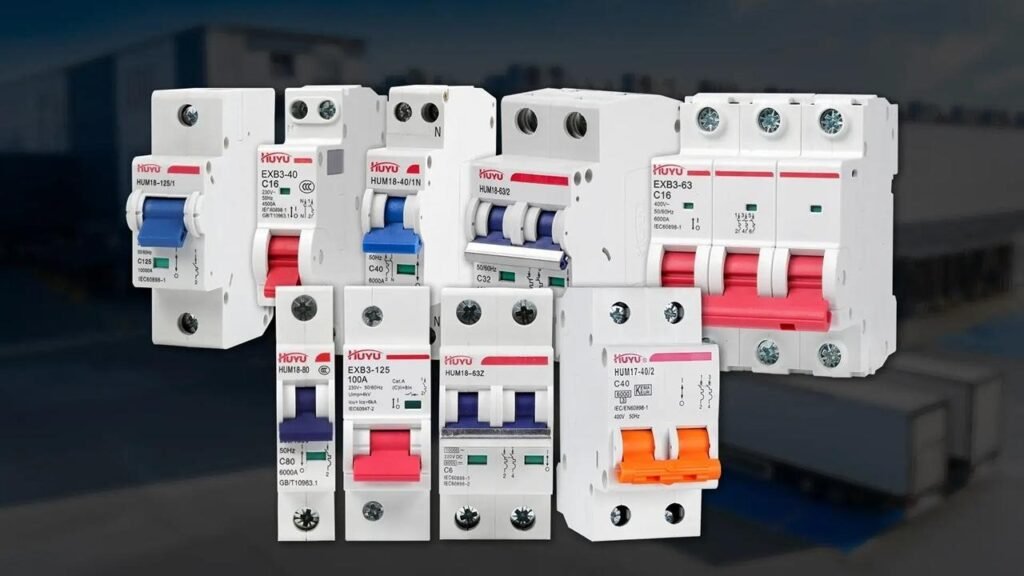
Huyu Electric miniature circuit breakers are available in different pole arrangements, such as single or double, triple and four poles. The poles should correspond to the design of the system. Single or double-pole MCBs are applied in single-phase circuits. Phase and neutral isolation can be separated in both directions in a device with two poles, and this may be necessary to ensure safety. Three-phase systems use MCBs with three or four poles to protect all the phases, and the neutral can also switch should the need occur. Isolation and protection. Due to the proper choice of pole, all live conductors are shielded and isolated in the event of an off-trip breaker.
Environmental and Installation Conditions
Environmental factors influence MCB performance. Temperature affects the thermal trip element. If a distribution board is installed in a hot environment, the MCB may trip at lower currents than expected. Huyu Electric provides technical data on temperature derating, and this must be considered during design. Altitude can also affect performance because air density impacts arc extinguishing. In high altitude installations, breaking capacity may be reduced. Engineers must verify that the chosen MCB remains suitable under these conditions. The enclosure rating and ventilation of the panel are also important. Adequate spacing and airflow help maintain stable operating temperatures and prevent nuisance tripping.
Mechanical Mounting and Wiring Practices
Proper installation is a requirement for good performance. Huyu Electric MCBs are normally mounted on the standard DIN rails within the distribution boards. The equipment should be firmly fastened to the rail to attain a stable mechanical action. During conductor termination, torque settings should be taken into consideration. Free-floating terminals may cause overheating and breakdown. Excessive tightening may destroy the terminal. The installer is supposed to adhere to the tightening torque that is required by the individual models. It is also important to prepare cables properly. The conductor length to be stripped must correspond to the terminal design, and stranded conductors might need ferrules in order to make good contact.
Positioning Within the Distribution Board
The layout of MCBs within a panel affects both safety and serviceability. Circuits should be clearly labeled to match the breaker positions. This helps during maintenance and fault-finding. Heat-generating devices should not be clustered excessively without spacing, as this can raise internal temperature. Sensitive circuits may be separated from heavy load circuits to reduce thermal influence. Neutral and earth bars should be arranged to avoid crossing and confusion. Good panel organization supports both safety and long-term reliability.
Testing and Commissioning After Installation
Functional checks to be done as post-installation. Before the installation, manually operate the breaker, and check insulation resistance to verify the absence of faults, trip testing under controlled conditions, visually check labeling, secure mounting and proper wiring. Record of breaker ratings and circuit information in the panel schedule to be used in the future.
Maintenance and Service Considerations
Despite the fact that MCBs are constructed to ensure they last long, they should be checked regularly. Timely respond to discoloration, overheating or damage. Tripping A frequent tripping is an indication of a load problem or a wrong choice of breaker; check it out instead of resetting it. When properly selected and mounted, Huyu Electric mini circuit breakers require little care and provide years of protection.
Conclusion
The miniature circuit breakers are small devices that play a significant role in terms of safety. Appropriate choice of rated current, breaking capacity, tripping curve, and pole arrangement is made to enable the device to be a reflection of the electrical system. Proper installation methods, such as proper mounting, proper wiring and consideration of the environmental factors, contribute to a reliable functional performance. Huyu Electric MCBs are created to address the requirements of modern low-voltage distribution, yet the effectiveness of this product is conditional on the competent engineering and design of installation. Engineers and electricians can construct reliable systems that are safe by using technical principles and precautionary techniques.